
On August 1, something important happened in the service world.
Maryland Governor Wes Moore, the new chair of the National Governors Association, launched Service United: a bipartisan effort calling on governors to create and expand paid service opportunities that address urgent community needs, build career pathways, and bring people together.
The accompanying Service United Fund launched with a $10 million commitment from the Andrew Carnegie Foundation, in partnership with the Schultz Family Foundation. The fund will award grants ranging from $100,000 to $1.5 million to help states and territories plan, launch, or strengthen service strategies aligned with their priorities.
Governor Moore also set an ambitious long-term goal: one million Americans engaged in service each year within the next decade.
That deserves celebration.
It also raises a time-sensitive question:
What must we build beneath this vision to help it succeed?
A movement cannot scale on spreadsheets and heroic effort
Every new service initiative creates an enormous amount of work beneath the surface.
Recruiting and selecting participants. Matching people with opportunities. Managing agreements and eligibility documents. Tracking hours, training, credentials, services, and outcomes. Supporting host organizations. Monitoring performance. Managing funding. Collecting stories. Learning what works. Improving the model. Reporting results to governors, legislators, funders, and communities.
Too often, every state, commission, intermediary, and program is expected to assemble these pieces independently.
That means more spreadsheets.
More disconnected systems.
More staff time spent rebuilding processes another organization has already figured out.
More information trapped inside individual programs rather than strengthening the larger service community.
And more talented people spending their days moving data around instead of supporting participants and communities.
A movement aiming to engage one million people each year cannot be held together by thousands of one-off databases, disconnected spreadsheets, and administrative processes rebuilt state by state.
We can do better.
Service can solve more than one problem at once
The promise behind Service United is refreshingly practical. And demonstrated by countless accomplistments by service orgs in the past.
Communities have work that urgently needs to be done.
Young people need meaningful opportunities to build skills, confidence, relationships, and careers.
And our country desperately needs more places where people from different backgrounds work alongside one another toward something larger than themselves.
Well-designed service programs can do all three.
They can put people to work addressing challenges in education, mental health, conservation, housing, public safety, disaster response, and other areas.
They can help participants earn credentials, meet employers, discover careers, and build professional networks.
And they can remind us that people who appear profoundly different on paper are often capable of building something meaningful together.
That is the power behind Service United’s promise:
Service from All. Opportunity for All.
Echoing the Clinton-era America Reads and America Counts initiatives, service is now moving even closer to the center of how states think about workforce development, community problem-solving, and civic connection.
Not as a nice extra.
Not merely as volunteerism.
As a serious strategy for developing talent, meeting community needs, and bringing people together.
But a serious strategy requires serious infrastructure.
Shared infrastructure creates shared possibility
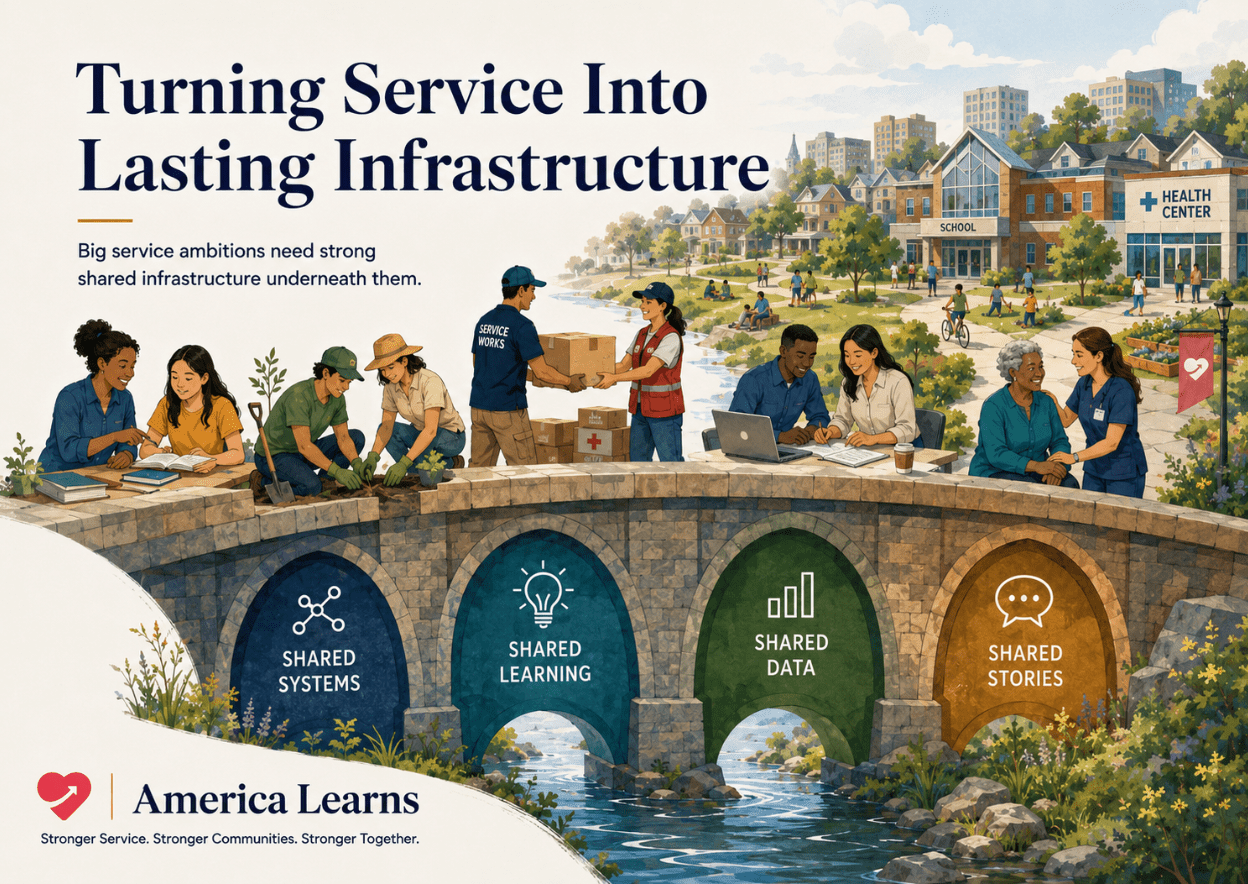
At America Learns, we believe the future of service depends partly on our ability to build infrastructure for the field, not just for individual organizations.
Infrastructure that can support AmeriCorps programs and other forms of state-based service.
Infrastructure that helps commissions, programs, participants, host sites, funders, and community partners work together.
Infrastructure that makes strong practices easier to share instead of forcing each program to reinvent them.
Infrastructure that allows leaders to see what is happening across an entire service ecosystem while still giving individual programs the flexibility to serve their own communities well.
The technology matters.
But shared infrastructure is larger than software.
It includes common processes, reusable tools, accessible knowledge, trustworthy data, strong learning communities, and ways for service leaders to learn from one another across programs and state lines.
Done well, shared infrastructure does not make service more bureaucratic.
It makes the bureaucracy less consuming.
It gives people more time to build relationships, solve problems, support participants, and strengthen communities.
Build the operating foundation from the beginning
As states begin designing new service strategies, the underlying operating infrastructure should be designed at the same time.
Otherwise, we risk creating innovative programs on top of the same fragmented administrative foundation that has limited learning and scale for decades.
Each state may create a different service model. That is a strength.
But every state does not need to independently invent how it will manage applications, participant records, host organizations, hours, outcomes, reporting, learning, and communication.
Every program does not need to create its own spreadsheet system.
Every initiative does not need to begin without access to what others have learned.
The National Governors Association plans to help participating states assess and scale different models while documenting their successes, challenges, pivots, costs, and transferable lessons.
That commitment to shared learning will be every bit as important as the new funding.
But shared learning requires more than publishing reports after the fact.
It requires structures that make it possible to capture useful information while the work is happening, recognize patterns across programs, and return that knowledge to the people doing the work.
State service commissions — the backbone of our nation’s service infrastructure — will be essential to making that possible.
This is a moment to build for abundance
There is a familiar pattern in our field.
A new initiative launches. Funding arrives. Smart, committed people work incredibly hard. Lives change.
But too much of what they build remains isolated inside one program, one grant, or one state.
The next group begins again.
Service United gives our community an opportunity to interrupt that pattern.
The goal should not simply be to launch more programs.
The goal should be to create a stronger service ecosystem—one where each new program benefits from what came before it and contributes something useful to everyone who comes next.
For more than two decades, America Learns has worked alongside the service community to build the operational backbone beneath this work.
We have seen what becomes possible when commissions and programs can spend less time reconstructing administrative systems—and more time learning from one another, supporting participants, strengthening partnerships, and delivering results.
We do not believe every organization should have to build these systems alone.
We believe the sector becomes stronger when the infrastructure is shared.
The invitation before us
Service United is an ambitious bet on people.
It is a bet that young adults are ready to contribute.
That communities possess wisdom and capacity waiting to be unlocked.
That governors from different parties can find common ground around meaningful work.
That service can create pathways forward while helping repair some of what feels fractured around us.
We believe it is also a bet on the larger service community.
Our responsibility now is to build the connective tissue that allows this vision to grow: shared systems, shared practices, shared learning, and shared stories.
Because movements need inspiration.
They also need somewhere strong enough to stand.